

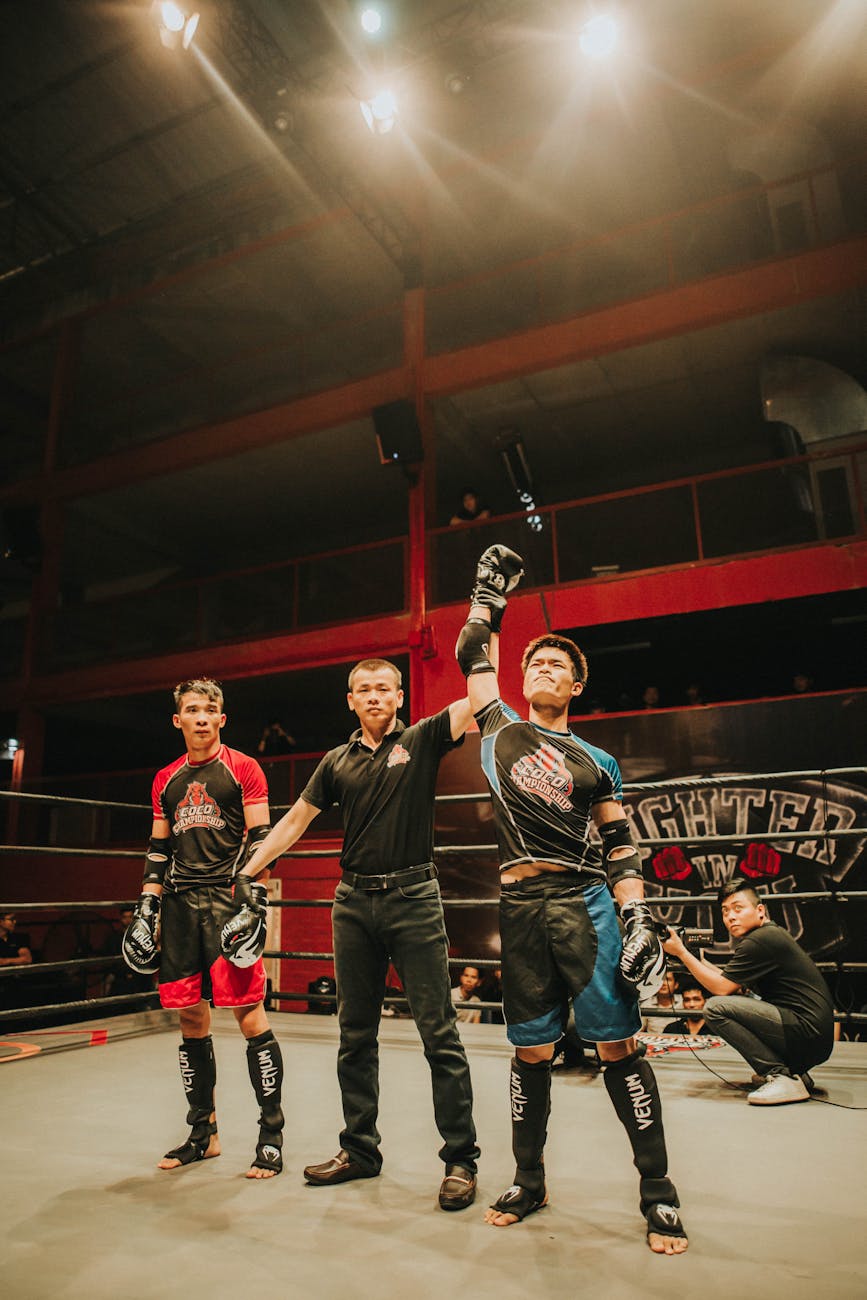
I love MMA.
I know, I know—it seems weird. I’m not exactly your typical MMA fan. My day-to-day life is pretty calm, structured, and, well… not full of punches to the face. But maybe that’s why I love it so much. It’s raw. It’s visceral. It’s adrenaline, grit, and sheer human will. And something about that contrast pulls me in.
Also, my boys are quick to point out that I “turn everything into a life lesson.” Guilty. I can’t help it—I’ve always loved the things that unfold visually and help explain the parts of life that aren’t as easy to see. So a few months ago while I was watching a fight, it hit me: this is trauma. Playing out in real time.
Here’s what happened.
It was the main event. Two strong, skilled fighters entered the cage, and somewhere in the first round, one of them took a clean punch to the eye. It split open a small cut above the brow—not a knockout blow, but a solid shot. His team patched him up between rounds, but from that moment on, the fight changed.
He changed.
He kept saying he was fine. His corner asked repeatedly—“Are you sure?”—and he nodded, “I’m good.” But he wasn’t. Not even close.
You could see him trying to guard the eye, which meant he left other parts of his body vulnerable. He was still fighting, still composed – like he was trying to shake it off, but he was off-balance. Even light contact to that side of his face made the wound to bleed more—until at one point, the blood was so heavy the commentators weren’t even sure what caused it.
“Was that from a punch?”
“I think it was just a brush.”
“There’s SO. MUCH. BLOOD.”
I was physically wincing – anticipating every blow. I sort of didn’t want to watch anymore but also I couldn’t turn away.
Eventually, his face swelled so badly and the bleeding got so severe that the medical team started shouting, “You’re going to lose your eye!” And the ref called the fight.
It was shocking… disturbing. But also … familiar.
Because trauma works the same way doesn’t it?
It starts with a punch—an incident, an experience, a betrayal that hits hard and fast. Sometimes it’s so jarring that we know we’re wounded. But often, we deny it. We minimize it. We say, “I’m fine,” even when we’re not. Because admitting it would be scary. Because treatment might hurt. Because pausing the fight feels like weakness.
We start compensating—guarding the wound so tightly that other parts of us become exposed. We don’t move freely anymore. We’re protecting. Anticipating. Bracing for the next hit.
And then even light contact—something that shouldn’t hurt—sends us spiraling. A word. A glance. An offhand comment. We bleed all over people who never really threw a punch.
And here’s the hardest part: in life, the fighters rotate.
Sometimes the person who lands a blow is someone we love. Someone who doesn’t know we were wounded there before. They don’t see it coming. They just see the aftermath—an overreaction that doesn’t make sense unless you’ve been watching since Round 1.
That’s the thing about trauma: it compounds. And it hides. And it lies.
It tells you you’re fine. It tells you to keep fighting. It tells you the bleeding is just part of it. Until suddenly, you’re one hit away from losing your eye.
That’s why healing starts with honesty.
It starts when we stop saying “I’m fine” just because we don’t want to face what’s really going on. It starts when we pause the fight, take a breath, and assess the places that hurt. Even if we’re scared. Even if it’s messy. Even if the wound traces all the way back to Round 1.
And most importantly, it starts when we surround ourselves with people who can see what we can’t. The ones who shout, “Get out of there! You’re not okay!” when we’re too numb or stubborn or scared to admit it ourselves.
I’m learning that I need those people.
I’m also learning to listen to them.
Because trauma isn’t weakness—it’s a wound. And healing isn’t cowardice—it’s the bravest thing we’ll ever do.
 Richelle Hofer
Leave a comment